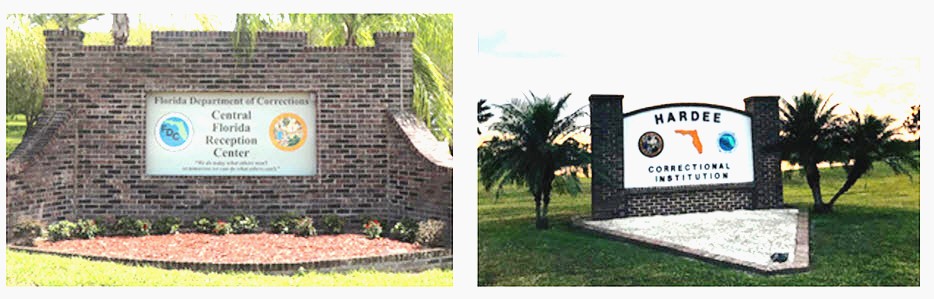
These are the prisons where the greyhounds are trained: Central Florida Reception Center (CFRC) in Orlando and Hardee Correctional Institution (HCI) in Bowling Green
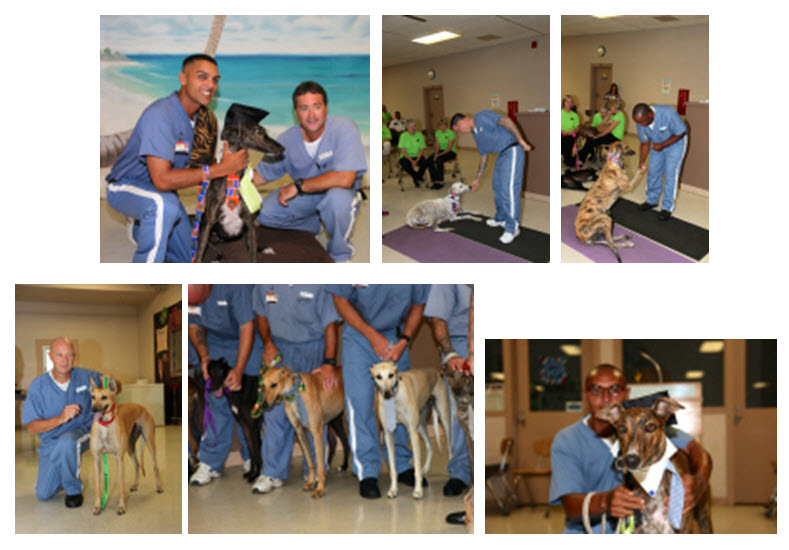 Inmate trainers with their greyhounds on Graduation Day
CERTIFICATION OF INMATE TRAINERS: The Greyhound Advancement Center’s training program has been certified by the State of Florida as an Occupational Credentialing Program for the inmate trainers. Each trainer can earn basic, intermediate, and advanced training certification as a dog trainer, depending on the number of dogs they have trained. This includes basic care, K9 CPR, obedience, behavioral assessments, journaling of training, and problem solving skills. Some of the inmates have never in their life done anything positive, so having a well-trained dog is a big accomplishment for them. It also helps them to learn important skills, such as working with other people and working with the different personalities of the greyhounds and other dogs they train. They can then use the certifications they earn when they are released to help them gain suitable employment.
THE SKILLS THE GREYHOUNDS ARE TAUGHT: The greyhounds are taught all of their basic commands: heel, sit, stay, wait, lie down on command, come on recall, finish, place (go to their bed and lie down), leave it, back up, and wait. The greyhounds are also taught to walk on slick floors, walk up and down stairs, jump up onto a platform (to simulate jumping into a vehicle), and door etiquette (not to go out of an open door or car door until their trainer gives the signal).
The inmate trainers become very knowledgeable, and after the greyhounds learn their basic commands, they are often taught some fun things. Some of our greyhounds have learned to play with a soccer ball, catch a tennis ball or Frisbee in the air, find a treat that is hidden, learned to play dead, shake hands (paws), bow, roll over and play dead, go into a crate and close the door by themselves, whisper, speak, jump through a hula hoop or over a jump, kiss, turn on lights, ring a bell, and sometimes even to “read”.
Greyhounds are sensitive and respond well to positive reinforcement (training treats). They can learn all of these commands and many more. Upon graduation, the greyhounds have learned all the requirements for the AKC’s Canine Good Citizen (CGC) certification and the Community Canine (CGCA) certification. They will also have learned the skills necessary to become a Certified Therapy Dog to take to assisted living facilities, hospitals, nursing homes, disaster areas, and schools. If you are planning on doing animal assisted therapy with your greyhound, a prison trained greyhound is definitely the way to go.
BOOT CAMP: During the summer months, it is too hot to ship the greyhounds from Ireland on the airplanes, so we do not have them in the prisons. We fill in with shelter dogs, and this is the time when your non-prison trained greyhound or other dog could go to the prison as a “boot camper.” This is a function of the Greyhound Advancement Center, so if you are interested in Boot Camp, please check with GAC.
HOW THE GREYHOUNDS HELP THE PRISONS: The mere presence of the greyhounds has made a huge difference at HCI and CFRC. The unconditional love of the greyhounds, as well as their calm and gentle demeanor, greatly improves the morale at the prison. This is true not only for the trainers, but for the prison staff, and even for the inmates not in the training programs. The inmate trainers have something positive to do with their time while incarcerated. They are responsible or their greyhound at all times. They learn responsibility, how to work together, and even learn viable job skills for when they are released. It is a wonderful program for the greyhounds and inmates alike.
Inmate trainers with their greyhounds on Graduation Day
CERTIFICATION OF INMATE TRAINERS: The Greyhound Advancement Center’s training program has been certified by the State of Florida as an Occupational Credentialing Program for the inmate trainers. Each trainer can earn basic, intermediate, and advanced training certification as a dog trainer, depending on the number of dogs they have trained. This includes basic care, K9 CPR, obedience, behavioral assessments, journaling of training, and problem solving skills. Some of the inmates have never in their life done anything positive, so having a well-trained dog is a big accomplishment for them. It also helps them to learn important skills, such as working with other people and working with the different personalities of the greyhounds and other dogs they train. They can then use the certifications they earn when they are released to help them gain suitable employment.
THE SKILLS THE GREYHOUNDS ARE TAUGHT: The greyhounds are taught all of their basic commands: heel, sit, stay, wait, lie down on command, come on recall, finish, place (go to their bed and lie down), leave it, back up, and wait. The greyhounds are also taught to walk on slick floors, walk up and down stairs, jump up onto a platform (to simulate jumping into a vehicle), and door etiquette (not to go out of an open door or car door until their trainer gives the signal).
The inmate trainers become very knowledgeable, and after the greyhounds learn their basic commands, they are often taught some fun things. Some of our greyhounds have learned to play with a soccer ball, catch a tennis ball or Frisbee in the air, find a treat that is hidden, learned to play dead, shake hands (paws), bow, roll over and play dead, go into a crate and close the door by themselves, whisper, speak, jump through a hula hoop or over a jump, kiss, turn on lights, ring a bell, and sometimes even to “read”.
Greyhounds are sensitive and respond well to positive reinforcement (training treats). They can learn all of these commands and many more. Upon graduation, the greyhounds have learned all the requirements for the AKC’s Canine Good Citizen (CGC) certification and the Community Canine (CGCA) certification. They will also have learned the skills necessary to become a Certified Therapy Dog to take to assisted living facilities, hospitals, nursing homes, disaster areas, and schools. If you are planning on doing animal assisted therapy with your greyhound, a prison trained greyhound is definitely the way to go.
BOOT CAMP: During the summer months, it is too hot to ship the greyhounds from Ireland on the airplanes, so we do not have them in the prisons. We fill in with shelter dogs, and this is the time when your non-prison trained greyhound or other dog could go to the prison as a “boot camper.” This is a function of the Greyhound Advancement Center, so if you are interested in Boot Camp, please check with GAC.
HOW THE GREYHOUNDS HELP THE PRISONS: The mere presence of the greyhounds has made a huge difference at HCI and CFRC. The unconditional love of the greyhounds, as well as their calm and gentle demeanor, greatly improves the morale at the prison. This is true not only for the trainers, but for the prison staff, and even for the inmates not in the training programs. The inmate trainers have something positive to do with their time while incarcerated. They are responsible or their greyhound at all times. They learn responsibility, how to work together, and even learn viable job skills for when they are released. It is a wonderful program for the greyhounds and inmates alike.
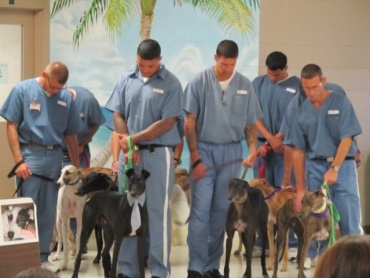 Some Inmate trainers during prayer at graduation
GRADUATION DAY: Graduation day is the day that you can take your greyhound home. It is an important, but bittersweet time for the greyhounds and their trainers. The trainers have the satisfaction of knowing that their greyhound will go on to a great life as a beloved pet, but it is difficult for them to give up the dogs that have meant so much to them for the past weeks. That is where we come in. We make sure that new greyhounds come in that same day, so the trainers have a new dog to work with and love.
Each session, one dog is chosen as “top dog” and one as “most improved”. These awards are given at the graduations. The trainers are very proud of these awards and the greyhounds that have earned them. The trainers will show you each dog individually, and demonstrate their commands. You will get to speak with your dog’s trainers after the graduation is over, and they can answer any questions you may have.
Afterward, the trainers love seeing photos of the greyhounds they have trained with their adopters and enjoying life in their new homes.
Some Inmate trainers during prayer at graduation
GRADUATION DAY: Graduation day is the day that you can take your greyhound home. It is an important, but bittersweet time for the greyhounds and their trainers. The trainers have the satisfaction of knowing that their greyhound will go on to a great life as a beloved pet, but it is difficult for them to give up the dogs that have meant so much to them for the past weeks. That is where we come in. We make sure that new greyhounds come in that same day, so the trainers have a new dog to work with and love.
Each session, one dog is chosen as “top dog” and one as “most improved”. These awards are given at the graduations. The trainers are very proud of these awards and the greyhounds that have earned them. The trainers will show you each dog individually, and demonstrate their commands. You will get to speak with your dog’s trainers after the graduation is over, and they can answer any questions you may have.
Afterward, the trainers love seeing photos of the greyhounds they have trained with their adopters and enjoying life in their new homes.
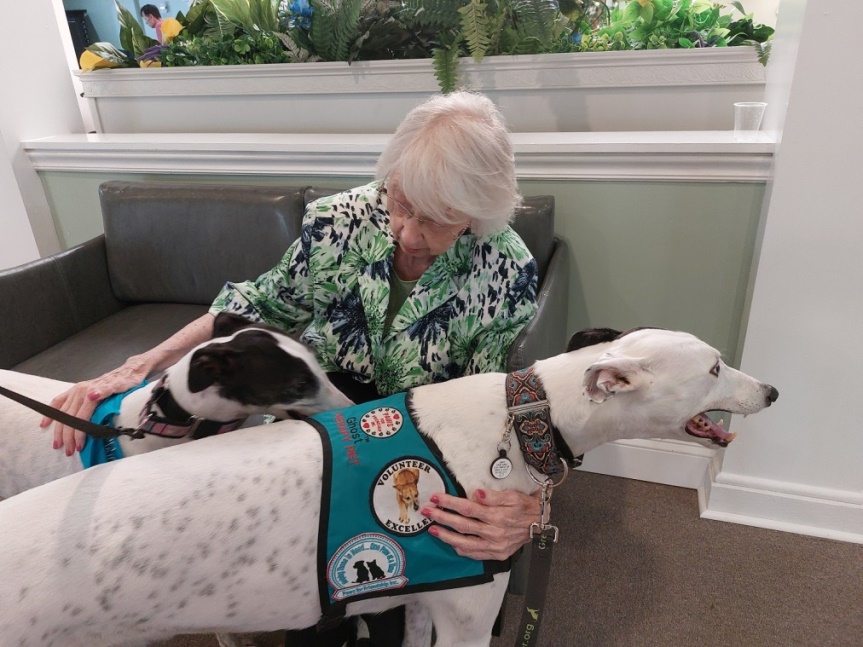 Phoebe and Ghost. Both graduated from the greyhound training program at CFRC and became Certified Therapy Dogs through Paws for Friendship. Here they are at a memory care facility.
For Additional Information:
For further information and training tips, please check out: www.greyhoundadvancementcenter.org
Phoebe and Ghost. Both graduated from the greyhound training program at CFRC and became Certified Therapy Dogs through Paws for Friendship. Here they are at a memory care facility.
For Additional Information:
For further information and training tips, please check out: www.greyhoundadvancementcenter.org